
Aligning initiatives is not a strategic management task.
Lack of alignment between strategic initiatives is one of the most common reasons for failed execution in corporate transformations. A 2021 study suggests that poor alignment and coordination as well as lack of commitment and understanding are amongst the key obstacles of failed strategy execution. They are all symptoms of siloed thinking and an overarching alignment vacuum, that is only exaggerated by an increased focus on efficiency and operations, while refusing to look left and right within the organization and connecting initiatives with the bigger picture. (Obstacles to strategy implementation and success factors: a review of empirical literature (Vigfússon et al., 2021)
For example a strategic data program must align their implementation of new roles and a new way-of-working within a bigger transformation of becoming an agile organization. If any of the new processes and roles fails to integrate into this bigger picture of the ongoing transformation, it can already be reworked immediately after its implementation due to necessary changes for the overarching agile transformation.
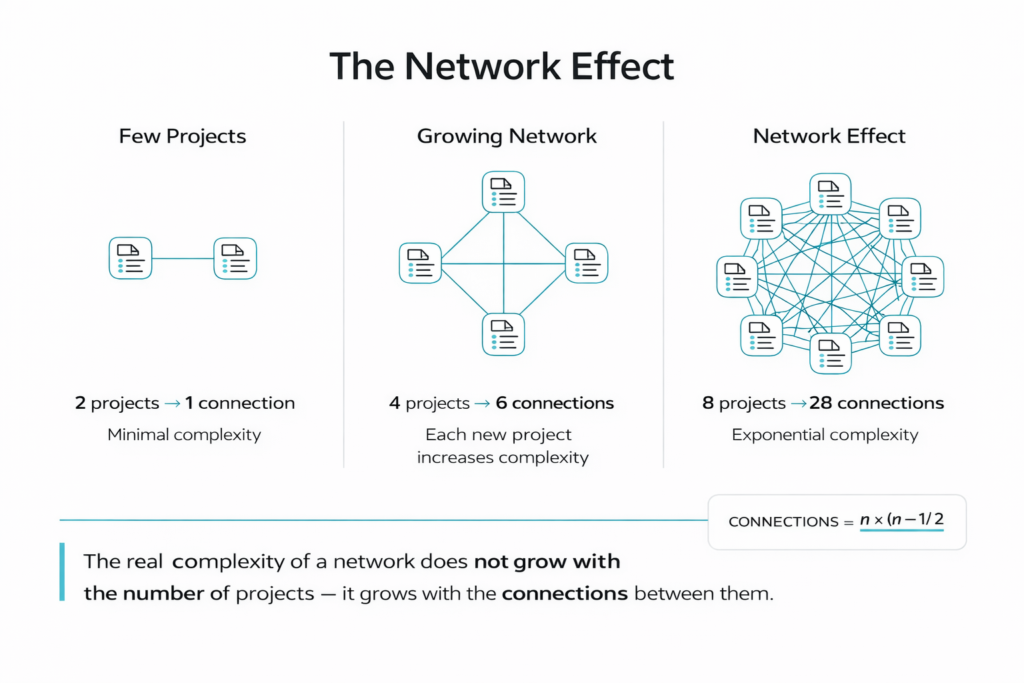
What seems obvious and relatively simple quickly becomes a daunting task with rising complexity due to the network effect. The number of node connections rises exponentially with the number of nodes. Where 2 initiatives have only one dependency, 8 initiatives already have 28 connections, hence dependencies.
Reduce complexity: Stay pragmatic.
Close and pragmatic alignment of initiatives is achieved by augmentation in shared objectives and lean direct alignment without detours and steering from upper management. Therefore, a pragmatic collaboration model is one of the 4 key artifacts of the TRAIIN framework for successful transformation.
Direct collaboration and alignment is fostered between the Objective Owners (Spotlight on: Objective Owner), which are accountable for the successful execution of a strategic objective, which maps to several connected initiatives. This is facilitated via a regular event series, called TRAIIN Refinement.
Structured, strategic alignment: Steering execution.
Objective Owners host a regular TRAIIN Refinement session. Its aim is to ensure that objectives are aligned and coherent. To achieve this, they resolve dependencies and obstacles from ongoing initiatives by prioritizing and acting within their competencies as fully enabled Objective Owners.
The refinement session enables Objective Owners to collaborate and support each other in reaching their goals. Objective Owners can only declare success if all objectives are achieved. Therefore the groups responsibility is to support each other and adapt their underlying initiatives.
This removes dependency from strategic management, reducing friction and streamlining strategic execution. Only if the competencies of the Objective Owners are exceeded, a TRAIIN Steering Event is to be scheduled for decisions that impact the success of the overall strategy (e.g. external constraints, scheduling in the bigger picture, budget overruns, etc..). This leads to strategic decisions that materialize in the adjustment of certain objectives.
Outcome focused agenda: For efficient collaboration.
TRAIIN Refinement meetings always cover the following three main agenda items:
- TRAIIN Map review: identify action areas
Create shared clarity on the latest progress and emerging risks, blockers and opportunities. Highlight Key Result status and their probability of achievement. - Decision making: Adjst course
Prioritize understaffed initiatives that truly matter and consciously de-prioritize or sequence the rest, always focusing on the critical path for achieving all short term OKRs and with that reach the Mid-Term Objective. - Connect the dots: Propagation in related initiatives
Translate the decisions into action items, and guidance for their connected initiatives. Leave room for reflection and definition of continuous improvement actions.
Three pitfalls which may get in your way of strategic alignment
- Too frequent / too infrequent
Scheduling TRAIIN Refinement sessions either too often or too rarely disrupts the balance between agility and focus, undermining the effectiveness of collaborative alignment. Schedule Refinements ad hoc if as soon as (new) opportunities or risks are realizing – otherwise keep a thigh cycle matching your average major transformation progress (e.g., Quarterly) - Low participation due to conflicting priorities
When Objective Owners are pulled away by competing demands, the collective power of the group to resolve dependencies and drive outcomes is diminished. This can only be resolved by enabling Objective Owners with the necessary capabilities and time allocation needed to thrive in their role. - Focusing on initiatives, not outcomes
Follow the Results Chain! Prioritizing the mechanics of initiatives over the achievement of Objectives leaves you with yet another Project Management meeting and dilutes the impact of the TRAIIN approach.
Final Thought
Sustainable transformation success with TRAIIN relies on pragmatic, outcome-driven alignment. Refinement events empower Objective Owners to collaborate directly, resolve dependencies, and focus on shared objectives, all while avoiding the pitfalls of poor cadence, disengagement, and initiative-centric thinking.
