
Recap: What are OKRs
Objectives and Key Results (OKRs) is a goal-setting best practice, helping organizations achieve ambitious objectives by specifying progress as measurable results. It’s ideally suited to focus on execution for major initiatives, such as complex transformations, fostering strong alignment, and transparency.
They are a proven methodology by trailblazers, such as Intel and Google. Though organizations regularly struggle to formulate key results in a pragmatic way, leading to fluffy outcomes and missed goals. A guide to OKRs and their applicability as cornerstone for TRAIIN can be found here.
This article points out the pitfalls of pragmatic key results definition and summarizes the art of formulating them meaningfully and applicable in the context of the TRAIIN framework.
Key Results measure the short-term strategy execution in the TRAIIN Map
Quantifying the TRAIIN Maps objectives, the main purpose of its key results is to answer the question “are we making progress towards our strategic goals?”. Due to its agile goal setting approach, as outlined in Spotlight on Timeline, only the objectives of the current year have accompanying key results. This creates focus on the short-term execution whilst mid- and long-term objectives connect the current initiatives with the transformations vision.
3 major pitfalls are holding organizations back of achieving strong execution through Key Results
OKRs are a proven track record creating clarity, accountability, and strong alignment within organizations to achieve meaningful goals, by focusing on execution of individual contributors and across several departments. Organizations that are not reaping these rewards, typically fall for the following 3 pitfalls when formulating their Key Results:
Pitfall 1: Key Results are unspecific and unmeasurable
Many organizations struggle to formulate pragmatic yet effective key results. For a successful implementation, key results must allow unambiguous measurability. Without this, they become unspecific, vague, and fail to deliver on their promise.
Pitfall 2: Key Results are just a list of project milestones
On the contrary, Key Results must also not simply represent a list of milestones of their respective projects. Even if there is a one-to-one connection, a project can be performed in scope, time, and budget, and still fail to deliver on its desired outcome, thus missing the set strategic objective.
This emphasizes TRAIIN’s nature as a transformation management framework. It does not substitute for the operational program management or its respective roadmap, yet it provides leaders with an elevated view for strategic decision making.
Pitfall 3: Key Results represent solely lagging outcomes
Outcome is a lagging indicator and only shows the results after the delivery of the underlying projects deliverables, therefore Key Results in the TRAIIN map evaluate the effectiveness of the underlying projects.
But outcomes are not suited for real time course corrections on project level. Therefore, they need to be accompanied by directive Key Results. As all other Key Results, directive Key Results are owned and monitored by the Objective Owner. They represent leading indicators that build confidence for the successful accomplishment of the Key Results. If they are missed, they create attention to a risk that needs to be managed or mitigated within the TRAIIN Refinement session.
A pragmatic guide: Meaningful Key Results span across the Results Chain
All three pitfalls can be overcome by using the right method, which is embedded in the TRAIIN framework: The Results Chain specifies all steps from input to delivered impact and supports leaders formulating precise yet pragmatic OKRs.
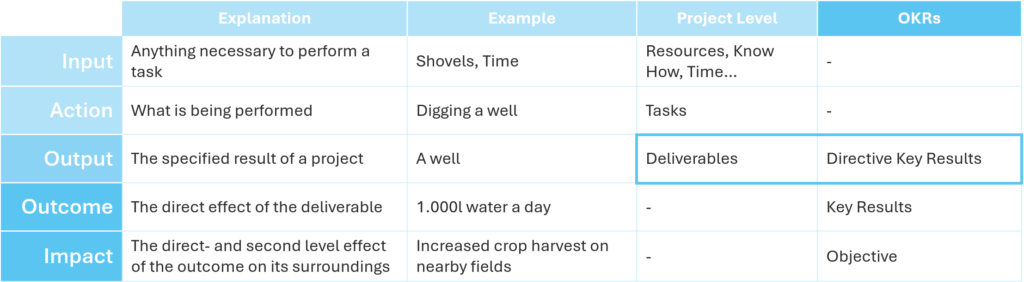
The table suggests the principle of using the Results Chain for OKR formulation on an easy-to-understand real world example: building wells to increase the crop harvest of a village.
The Objective represents a strategic goal which is achieved as a direct or indirect impact of the underlying initiatives: Increased crop harvest on village fields through increased watering.
It is measured by multiple Key Results – if all Key Results are reached, the Objective is reached. Key Results should not simply be milestones from underlying projects, as they do not substitute for a project roadmap. Rather, they represent the outcome, that is attained by the underlying initiative which actually drives the successful accomplishment of the objective. An example for an applicable Key Result is: 1.000 liters of water a day for watering.
At least 1 Key Result should provide a directive element that indicates whether execution is on the right track. An early warning sign that highlights risks or delays in the successful execution. Applicable measures can be found on the Output level of the results chain, which contains project deliverables and milestones. An example for a directive Key Result: The well is finished at a specific date.
Formulating stronger OKRs (Examples)
Having used the Results Chain as basis for improved OKR formulation, already brought you half way there. Here are some further best practices to help you formulate your OKRs
Objectives should be:
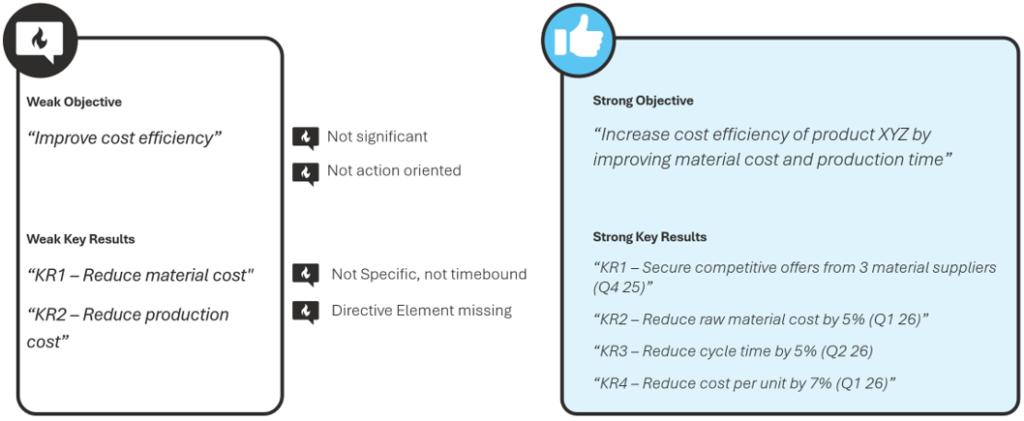
- Specific & concrete: Though Objectives are recommended to be qualitative, they should provide clarity to what is going to be achieved. The TRAIIN Map then does the job of linking it with the rest of the strategic goals and the overarching vision.
- Action oriented: The objective should already provide a general direction on how it is going to be reached
- Inspirational: If your team reaches all its objectives consistently, they might not be challenging enough, a 50/50 chance of accomplishment is usually a good indication, if an objective is inspirational enough.
Key Results should be:
- Specific & timebound: A key result without a number that can be actually assessed and measured, and without a due date is not a key result.
- Aggressive, yet realistic: If a team consistently meets all objectives, they’re likely not ambitious enough (see Inspirational).
- At least 1 directive element: At least one Key Result should act as a directive early-warning indicator, drawn from the output level of the results chain, to show whether execution is on track.
The following shows an example for a weak and an improved OKR.
Conclusion
The definition of measurable and specific key results is the key to its successful implementation. With it, they drive alignment and focused execution towards the strategic vision. Therefore, they are the cornerstone of the short-term strategic goals of the TRAIIN map.
